June 15, 2013

“Give me liberty or give me death!” – or maybe a tax exemption, immortality, a Benz, or beer…


THE FAMED (AND POSSIBLY FALSE) REVOLUTIONARY WAR QUOTE:

“Give me liberty or give me death!”
       Attributed to Patrick Henry (1736-1799)
       American attorney, politician and Founding Father
       According to tradition, Henry said these words at the end of a speech he made in the Virginia House of Burgesses on March 23, 1775.
       It’s true that, on that date, Henry gave an impassioned speech in favor of mobilizing the Virginia militia to fight against the British at a meeting of the Virginia House of Burgesses. But neither Henry nor anyone else wrote down what he said at the time. Forty-two years later, a posthumous biography of Henry included a “reconstructed” version of the speech, based largely on the recollection of one aging judge who’d heard it. This popular biography, written by William Wirt, was the first source to put “Give me liberty or give me death!” in Henry’s mouth. It made the quote legendary and many books and websites have republished Wirt’s recreation of the speech as if it were an actual contemporary recording of what Henry said. Modern quote scholars like Fred Shapiro, editor of The Yale Book of Quotations, and Ralph Keyes, author of The Quote Verifier, view Wirt’s version of Henry’s speech with skepticism and doubt that Henry actually uttered his famous alleged quotation. (For more background, see this post on my This Day in Quotes site.)


THE MODERN TEA PARTY VARIATION:

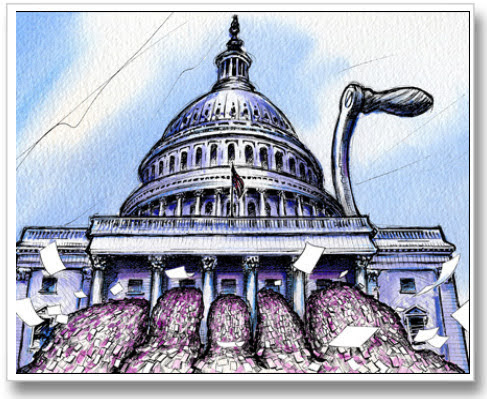
“Give me tax exempt 501(c)4 or give me death!”
      Matt Davies
       Pulitzer Prize-winning editorial cartoonist for Tribune Media Services and The Hearst Newspaper Group
       Caption of a June 2013 political cartoon by Davies lampooning the outrage of conservative Republicans over revelations that the IRS had challenged requests of Tea Party groups who wanted the tax exempt status supposedly reserved for organizations that are “operated exclusively for the promotion of social welfare.”


THE FIRESIGN THEATRE VERSION:

“Give Me Immortality or Give Me Death”
       The Firesign Theatre
       American comedy troupe
       Title of a Firesign album title released in 1998 by Rhino Records


THE LITIGIOUS EX-MISTRESS VERSION:

“Give Me Hush Money Or Give Me Benz!!”
       Headline of a TMZ.com story about basketball star Stephon Marbury and Thurayyah Mitchell, “the personal chef he boinked, while he was married, back in 2006.”
       According to the story, Marbury had promised to pay Mitchell $900,000 to keep quiet about the affair, but stopped making payments around the $600,000 mark. Mitchell took him to court and a judge ordered him to pony up the remaining $331,584.50. When Mitchell didn’t pay up in a timely fashion, Mitchell went back to court, asking that Marbury be forced to give her his Mercedes-Benz and other assets to settle the debt.


AL BUNDY’S GREAT WINE VS. BEER RANT:

“Americans don’t like wine. We like beer. Ice cold. Ice cold, best in a bottle, but find in any way you can get it, belching, burping, wake-up-in-a-pool-of-it beer. So let’s show them...Let’s strike a blow anywhere they dine alfresco, anywhere they eat Brie cheese, and anywhere they wear their pants up high around their waist in the European way. The only thing Americans understand is mindless Tom and Jerry cartoon violence. So, let’s go kick some elite butt. Give me beer, or give me death!”
       Al Bundy (played by actor Ed O’Neill) 
       Part of a speech Al gives in the “Chicago Wine Party” episode of the American comedy TV show Married with Children (Season 7, Ep. 7, Nov. 1, 1992)
       In this episode, he makes the speech to a group of fellow beer fans who oppose a City Council plan to increase the local tax on beer but not on wine.

*     *     *     *     *     *     *     *     *     *

Comments? Corrections? Post them on the Famous Quotations Facebook page.

Related reading, listening and viewing…

May 29, 2013

Eternal vigilance is not only the price of liberty...


ORIGIN OF THE FAMOUS QUOTE:

“Eternal vigilance is the price of liberty.”
      
Wendell Phillips (1811-1884)
       American Abolitionist and liberal activist
       In a
speech to the Massachusetts Anti-Slavery Society on January 28, 1852
       This quotation is often mistakenly attributed to Irish lawyer and politician John Philpot Curran (1750–1817) or to various American Founding Fathers, most commonly Thomas Jefferson. Similar quotes by Curran, Jefferson and others do predate the speech by Phillips, but he created the formulation we are most familiar with today in his 1852 speech.
       What Curran said, in
a speech in Dublin on July 10, 1790, was: “The condition upon which God hath given liberty to man is eternal vigilance.”
       The common misattribution to Thomas Jefferson may derive from a quote inscribed on the Jefferson Memorial in Washington, DC: “I have sworn upon the altar of God, eternal hostility against every form of tyranny over the mind of man.” This comes from a
letter Jefferson wrote to Dr. Benjamin Rush on September 23, 1800, in which he stressed his determination to prevent Christian clergyman from imposing their particular brands of religion on other Americans.
       See
this post on my This Day in Quotes site for more background.


A RECENT USE THAT IS SHAMEFULLY APPROPRIATE:

“The IRS admitted that they targeted tea party groups to try and silence our voices...The price of liberty is eternal vigilance.”
      
Adrienne King
       Former head of the Honolulu Tea Party
       Remarking on the revelation that apparently politically-motivated bureaucrats at the IRS had targeted Tea Party groups to challenge their tax-exempt status, an amazingly dumb move that gave conservative activists like King more ammunition against the Obama administration. Quoted in
an article in the Hawaii Reporter, May 10th, 2013.


DUTCH’S LAW:

“Eternal vigilance is not the price of liberty. It’s the price of everything. Every object you own has to be maintained. In society, there will always be people who oppose whatever you hold dear. They will try to overturn, evade or weaken your reforms. Others will seek power, wealth, or status without doing any work. The only way to keep what you have is to guard it constantly.”
      
Prof. Steven Dutch
       Professor of Natural and Applied Sciences, University of Wisconsin–Green Bay
       One of
Dutch’s Laws of Just About Everything 


ALDOUS HUXLEY’S TAKE:

“Eternal vigilance is not only the price of liberty; eternal vigilance is the price of human decency.”
      
Aldous Huxley (1894-1963)
       English novelist and social critic
       From his introduction to the radio version of his novel Brave New World,
produced by William Froug for CBS Radio in 1965


COLD WARRIOR QUOTE:

“The price of freedom is eternal vigilance and a willingness to act in its defense.” 
      
George P. Shultz
       U.S. Secretary of State under President Ronald Reagan
       A saber-rattling variation
attributed to Schultz


SURFING FREEDOM VARIATION:

“The price of surfing freedom is eternal vigilance.”
      
Jay Garmon 
       A “professional geek, Web entrepreneur, and occasional science fiction writer”
       In a
post about online privacy tools (and the unfortunate need for them)

*     *     *     *     *     *     *     *     *     *

Comments? Corrections? Post them on the Famous Quotations Facebook page.

Related reading…

May 17, 2013

“The reports of my death are greatly exaggerated.”


THE FAMOUS MISQUOTE:

“The reports of my death are greatly exaggerated.”
       Attributed to Mark Twain (1835-1910)
       American humorist, journalist, novelist and social critic
       According to a widely-repeated legend, Twain made this quip when he heard there were rumors he had died and that one newspaper had printed his obituary. Another common variation of the line uses the words “…have been greatly exaggerated.” Sometimes the quip is given as “Reports of my death are grossly exaggerated.”
       However, all of the commonly-heard versions using “greatly exaggerated” or “grossly exaggerated” are misquotes.
       As noted in many scholarly books of quotations and explained in a post on my This Day in Quotes blog, what Twain actually said was “The report of my death was an exaggeration.”
       The origin of the more familiar misquote versions of Twain’s response seems to be an embellished anecdote in Chapter 197 of Albert Bigelow Paine’s biography of Twain, which was published in 1912, two years after Twain’s death.


A RECENT PARAPHRASE BY PRESIDENT OBAMA:

“As Mark Twain said, you know, rumors of my demise may be a little exaggerated at this point.”
       President Barack Obama
       His response during a White House press conference on April 30, 2013, when a reporter asked if he still had the political “juice” needed to get his legislative proposals passed by Congress, in light of his recent high profile failures to get gun control and budget legislation approved.


THE DICK CHENEY INVERSE PARAPHRASE:

“The rumors that Cheney is alive are somewhat exaggerated. It’s Mark Twain in reverse.”
       Hans Blix
       Swedish diplomat and politician
       His answer in a 2004 interview in the New York Times when asked if US Vice President Dick Cheney had seemed more “wooden” than President George W. Bush during a meeting Blix had with them prior to the Second Gulf War (a.k.a. the 2003 invasion of Iraq).
       Blix led the international weapons inspection teams charged with determining if Iraq had weapons of mass destruction, a claim Bush and Cheney pushed as the main reason to invade the country. As Blix pointed out, no WMDs were found. Of course, this fact was was dismissed by Bush and Cheney.


THE SOAP OPERA VERSION:

“Rumors of my chastity have been greatly exaggerated.”
       Donna Martin, a character played by actress Tori Spelling in the TV series Beverly Hills, 90210
       One of her wisecracks in the “Reunion” episode (Season 8, Ep. 27, first aired April 15, 1998)


THE SPACE OPERA VERSION:

“Reports of my assimilation have been greatly exaggerated.”
       Captain Jean-Luc Picard, played by actor Patrick Stewart
       A quip Picard makes in the movie Star Trek: First Contact (1996), in which some crew members of the USS Enterprise are “assimilated” by the part-machine, part-organic, hive-like life form(s) called the Borg.

*     *     *     *     *     *     *     *     *     *

Comments? Corrections? Post them on the Famous Quotations Facebook page.

Related reading and viewing…

May 3, 2013

“Art for art’s sake.” (“L’art pour l’art.”)


COUSIN’S FAMOUS EARLY USE:

“Art for art’s sake.” (“L’art pour l’art”)
      
Victor Cousin (1792-1867)
       French philosopher 
       Famous phrase first used by Cousin in a lecture at the Sorbonne (University of Paris) in 1818
       Cousin
is widely credited with either coining or uttering the first notable public use of the phrase “l’art pour l’art,” during his lecture on aesthetics titled “Du Vrai, du Beau, et du Bien” (“Truth, Beauty and Goodness”). In his hifalutin’ remarks on those topics, Cousin said:  
      
“We must have religion for religion’s sake, morality for morality’s sake, as with art for art’s sake...the beautiful cannot be the way to what is useful, or to what is good, or to what is holy; it leads only to itself.”  
       Cousin’s use gave the concept of “art for art’s sake” it’s initial notoriety. However, credit for popularizing and promoting it to encourage the creation of art that is not limited by realism or social usefulness is generally given to the French writer and art critic
Théophile Gautier, who began using it in the mid-1830s. It became a philosophical basis of the so-called Aesthetic Movement in art and literature that developed in the 19th Century.


HUGO’S OBSERVATION:

“Art for art’s sake exists in nature more than is believed.” 
      
Victor Hugo (1802-1885) 
       French novelist, playwright and poet

       From his novel
L’Homme Qui Rit (The Man Who Laughs), first published in 1869


CAO YU’S OBSERVATION:

“Art for art’s sake is a philosophy of the well-fed.” 
       Cao Yu (1910-1996)
       Chinese playwright
       Quoted
in the London Observer, April 13, 1980


SAND’S VISIONARY VARIATION:

“Art for art’s sake is an empty phrase. Art for the sake of the true, art for the sake of the good and the beautiful, that is the faith I am searching for.” 
       George Sand (pseudonym of Baroness Amandine Aurore Lucile Dupin; 1804-1876)
       French writer
       Comment
in a letter to her friend Alexandre Saint-Jean in 1872


FREBERG’S PECUNIARY VARIATION:

“ARS GRATIA PECUNIAE.” (“Art for the sake of money.”)
      
Stan Freberg (b. 1926)
       American comic genius and occasional ad man
       Motto on the “The Great Seal of Freberg,” which features a a seal with sunglasses. Devised for his advertising agency “Freberg Ltd. (But Not Very).”


ABBEY’S IDEOLOGY VARIATION:

“Growth for the sake of growth is the ideology of the cancer cell.”
      
Edward Abbey (1927-1989)
       American writer and environmental activist
       In his article “Grow and Die,”
published in Penthouse magazine, September 1979


THE MOVIE VERSION:

“ARS GRATIA ARTIS”
       The famed motto of Metro-Goldwyn-Mayer studios
       Around 1916, Hollywood publicist Howard Dietz was asked to develop a motto for Metro-Goldwyn-Mayer studios. He came up with “Ars gratia artis,” a Latin version of the phrase “art for art’s sake.”
       Through most of the decades since then, the motto has appeared over the image of a roaring lion at the beginning of films produced by MGM.

*     *     *     *     *     *     *     *     *     *

Comments? Corrections? Post them on the Famous Quotations Facebook group.

Related reading…

April 23, 2013

“We have met the enemy and he is us.”


THE FAMOUS EARTH DAY SLOGAN:

“We have met the enemy and he is us.”
      
Walt Kelly (1913-1973)
       American cartoonist best known for his
Pogo comic strip
       Kelly used this memorable line on a poster designed to help promote environmental awareness and publicize the first annual observance of Earth Day, held on April 22, 1970. It’s based on “We have met the enemy and they are ours” — the famous report made by American Navy Commodore Oliver Hazard Perry on September 10, 1813, after defeating a British naval squadron on Lake Erie during the War of 1812. (For more background see the
April 22 Earth Day post on ThisDayinQuotes.com.)


THE ANTI-US KILLERS VERSION:

“We have met the enemy, and he is not us. He is a shadowy figure that hates the Western world, hates freedom, hates women, and hates liberty of the individual.”
      
A post on the “EvilProf” blog about anti-American terrorists


THE KILLER KITTIES VERSION:

“We have met the enemy, and they are our cats. A report published in Nature asserts that cats might kill as many as 20 billion mammals — and possibly more than three million birds — every year.”
      
MSN news brief about a study that concluded cats that roam outdoors are one of the top threats to wildlife. The story noted one old-fashioned way of reducing the carnage your cat may cause (besides keeping it indoors): put a bell on its collar.


THE MOVIE BUZZKILL VERSION:
 
“A wasted opportunity to explore one of the last great moments of American dissent. We have met the enemy, and it is dull.”
      
Alonso Duralde
       Movie critic for Reuters’ TheWrap.com
      
In his review of The Company You Keep, Robert Redford’s film about aging radicals who were members of the Weather Underground in the 1960s.

To read more “We have met the enemy…” variations, see this previous post on QuoteCounterquote.com…

*     *     *     *     *     *     *     *     *     *

Comments? Corrections? Post them on the Famous Quotations Facebook page.

Related reading…

Copyrights & Disclaimers

Copyrights © 2009-2013 by Subtropic Productions LLC

Creative Commons License

The Quote/Counterquote blog is licensed under a Creative Commons Attribution 3.0 United States License. Any duplicative or remixed use of the original text written for this blog and any exact duplications the specific sets of quotations collected for the posts shown here must include an attribution to QuoteCounterquote.com and, if online, a link to http://www.quotecounterquote.com/

To the best of our knowledge, the non-original content posted here is used in a way that is allowed under the fair use doctrine. If you own the copyright to something we've posted and think we may have violated fair use standards, please let me know.

Subtropic Productions LLC and QuoteCounterquote.com are committed to protecting your privacy. We will not sell your email address, etc. For more details, read this blog's full Privacy Policy.