Showing posts with label Benjamin Franklin. Show all posts

June 30, 2018

“Early to bed and early to rise…”

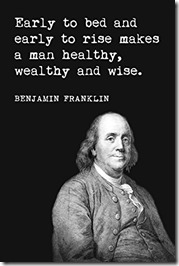
Early to Bed Ben Franklin poster

BEN’S BORROWED ADVICE:

“Early to bed and early to rise,               
Makes a man healthy, wealthy, and wise.”

       Benjamin Franklin (1706-1790)
       American author, publisher, scientist, diplomat and Founding Father
       One of the proverbial sayings Franklin included in Poor Richard's Almanack, which he published from 1732 to 1758 under the pseudonym Richard Saunders.
       Franklin is sometimes wrongly credited with coining this familiar poetic adage. But, like most of the sayings he used in various editions of his popular almanac, he borrowed it from other sources. He wrote in the 1746 edition: “I know as well as thee, that I am no poet born; and it is a trade I never learnt, nor indeed could learn…Why then should I give my readers bad lines of my own, when good ones of other people’s are so plenty?”
       The “Early to bed...” saying is an old English proverb dating back to at least 1486. Franklin first used it in the 1735 edition of Poor Richard's Almanack.
       (The image at left is the “‘Early To Bed And Early To Rise’ motivational poster” offered on Amazon.)

James Thurber

THURBER’S COUNTERQUOTE:

“Early to rise and early to bed makes a male healthy and wealthy and dead.”
       James Thurber (1894-1961)
       American writer, cartoonist and playwright             
       The moral of his story “The Shrike and the Chipmunks,” originally published in the February 18, 1939 issue of New Yorker magazine, then included in his book Fables for Our Time and Famous Poems Illustrated (1940).             
       Thurber’s fables were humorous versions of Aesop’s Fables. “The Shrike and the Chipmunks” features a male and female chipmunk. The male is a slob who likes to sleep all day and doesn’t go out of their cave until after dark. One evening when the male chipmunk goes outside, a shrike decides to swoop down and try to catch him. But the bird, unnoticed by the chipmunks, “could not see very well on account of the dark, so he batted his head against an alder branch and was killed.” Not long afterward, the female chipmunk berates the male for being lazy. She makes him go outside with her for a walk in the sun to get some exercise — and they are both caught and killed by a different shrike. The story ends with the Aesop-like line: “Moral: Early to rise and early to bed makes a man healthy and wealthy and dead.”

James_Garner_Bret_Maverick

PAPPY MAVERICK’S VARIATION:

“Remember what Pappy used to say: ‘Early to bed and early to rise is the curse of the working classes.’”
       Bret Maverick (played by actor James Garner)
       Recalling one of the many sayings of his father Beau Maverick, in “The Rivals” episode of the Western TV series Maverick. (First aired January 25, 1959)
       Sayings by Beau "Pappy" Maverick are mentioned many times during the course of the series by Bret and his brothers Bart, played by Jack Garner, and Beau (named after his father), played by Roger Moore. He is finally seen in the September 19, 1959 episode titled “Pappy,” in which he is played by James Garner.

Laurence J. Peter

PETER’S OTHER PRINCIPLE:

“Early to bed and early to rise — till you get enough money to do otherwise.”
       Laurence J. Peter (1919-1990)
       Canadian author, educator and hierarchiologist best known to the general public for the formulation of the “Peter Principle” (“In a hierarchy, every employee tends to rise to the level of his incompetence.”)
       This “early to bed…” variation is one of the sayings included in his book Peter's Almanac (1924)

Early to bed - Garfield, June 25, 2018 color

GARFIELD’S ADDITION:

JON: “I like this saying by Benjamin Franklin. ‘Early to bed and early to rise makes a man healthy, wealthy and wise.’
GARFIELD: “And lonely, dateless and boring.”             
       The June 25, 2018 edition of the Garfield comic strip, created by Jim Davis

Early to Bed... From Earl Moran calendar Aug 1950 REV2

THE CALENDAR GIRL’S CAPTION:

“Early to bed
May make you wise,
But staying out late
Will get you more guys.”

       The caption of artist Earl Moran’s “good girl art” illustration for the August page in the 1950 Paramount Oilless Bearing Co. calendar

*     *     *     *     *     *     *     *     *     *

Comments? Corrections? Email me or Post them on the Famous Quotations Facebook page.

Related reading, listening & stuff…

December 6, 2017

“Know thyself.” (And thy enemy.)

  
Temple of Apollo at Delphi WM

FAMOUS MAXIM OF THE GREEK SAGES:

“Know thyself.” (“Gnothi seauton.”)
       A saying inscribed at the Greek Temple of Apollo at Delphi (4th century BC)             
       This oft-quoted advice is generally attributed to “The Seven Sages of Greece,” a group of famous Greek philosophers, statesmen and politicians. It’s one of 147 pithy sayings inscribed at Delphi.             
       Some of those sayings have been attributed to specific sages. For example, “Know thyself” has been credited to the philosopher Thales, the Greek statesman Solon, and several other Greek wise men.
       However, it’s likely that it and many other maxims inscribed at the Temple of Delphi are proverbial sayings that predate the Seven Sages.       

tao-te-ching

THE CHINESE SAGE’S VERSION:

“He who knows others is wise. He who knows himself is enlightened.”             
       One of the most-cited quotes from the Tao Te Ching (a.k.a. the  Daodejing or Dao De Jing), a fundamental text of Taoism dating back to the 6th Century BC
       This quote is traditionally attributed to Lao-Tzu (a.k.a.  Lao-Tze or Laozi), the legendary, possibly mythical founder of Taoism who is generally credited with authorship of the Tao Te Ching.  
       Modern scholars tend to believe that text is probably a compilation of ancient Chinese wisdom, rather than the creation of one man.

 Sun Tzu the Art of War

THE CHINESE GENERAL’S VERSION:

“Know your enemy and know yourself, find naught in fear for 100 battles. Know yourself but not your enemy, find level of loss and victory. Know thy enemy but not yourself, wallow in defeat every time.”
        Sun-Tzu (c. 544 BC-496 BC)
        Chinese general, military strategist, and philosopher             
        This is one of the most popular pieces of wisdom in his famed work The Art of War (5th century BC).
        Although “Know thy enemy” and the variation “Know thine enemy” sound like and are sometimes assumed to be Biblical in origin, there is no such quote in the Bible. (Check it yourself if you don’t believe me.)

Benjamin Franklin, Poor Richard's

“POOR RICHARD’S” OBSERVATION:

“There are three things extremely hard: steel, a diamond, and to know one’s self.”
       Benjamin Franklin (1705-1790)
       American author, inventor, writer, publisher and statesman
       A saying recorded the 1750 edition of Poor Richard’s Almanack, a yearly almanac published by Franklin under the pseudonym of “Poor Richard” Saunders.

Oscar Wilde

A BRIT WIT’S COUNTERQUOTE:

“Only the shallow know themselves.”
       Oscar Wilde (1854-1900)
       Irish poet and playwright
       From his collection of aphorisms “Phrases and Philosophies for the Use of the Young,” first published in December 1894 in the one and only issue of the Oxford student magazine The Chameleon.

Andre Gide by_Laurens

A FRENCH WRITER’S COUNTERQUTE:

“‘Know Thyself’ – a maxim as pernicious as it is odious. A person observing himself would arrest his own development. Any caterpillar who tried to ‘know himself’ would never become a butterfly.”
       André Gide (1869-1951)
       French writer and left-leaning political activist
       A comment in his 1935 book Les Nouvelles Nourritures, meaning “The New Foods” in English. That rambling, part-philosophical, part-poetic, part-political work is a followup to Gide’s Les Nourritures Terrestres, or “Foods of the Earth,” (1897).

Henry Miller

HENRY MILLER’S DARK VIEW:

“The study of crime begins with the knowledge of oneself.”
       Henry Miller (1891-1980)
       American writer best known for his boundary-pushing, semi-autobiographical novels             
       A line from his memoir The Air-Conditioned Nightmare (1945), an account of a year-long trip he took across the United States in 1939 after living in Paris for nearly a decade.
        After the quote above, Miller goes on to say: “All that you despise, all that you loathe, all that you reject, all that you condemn and seek to convert by punishment springs from you. The source of it is God whom you place outside, above and beyond. Crime is identification, first with God, then with your own image.”

For fun, also see the video riff on “Know thyself” that I posted on YouTube.

*     *     *     *     *     *     *     *     *     *

Comments? Corrections? Email me or Post them on the Famous Quotations Facebook page.

Related reading…

January 17, 2017

“Nothing is certain except death and taxes.” (Or, as Franklin actually said: “Il n’y a rien d’assure que la mort et les impôts.”


THE FAMOUS WORDS FRANKLIN DIDN’T SAY (IN ENGLISH):

“Nothing is certain except death and taxes.”
      
Benjamin Franklin (1706-1790) 
       American “founding father,” publisher, diplomat and scientist 
       This is the usual English translation of a comment Franklin made
in a letter he wrote to French scientist Jean-Baptiste Leroy, dated November 13, 1789.
       Franklin wrote his letter to Leroy in French. His “death and taxes” remark was related to the Constitution of the United States of America, which had been adopted two years earlier. What he actually wrote was:
       “Notre constitution nouvelle est actuellement établie, tout paraît nous promettre qu’elle sera durable; mais, dans ce monde, il n’y a rien d’assure que la mort et les impôts.”
       The common English translation of this sentence is: “Our new Constitution is now established, everything seems to promise it will be durable; but, in this world, nothing is certain except death and taxes.”  (Sometimes the last part is translated as “
Nothing is certain but death and taxes.”)
       As noted by the invaluable
Phrase Finder site and other reference sources, similar quotations about death and taxes pre-date Franklin’s letter. But the English translation of Franklin’s version is certainly the most famous. (For more background see this post on my ThisDayinQuotes.com blog.)

Donald Trump cartoon from usnewscom

THE DONALD TRUMP UPDATE:

“With Donald Trump as President almost nothing is certain except uncertainty itself.”
       David C. Kibbe
       President and CEO of the non-profit healthcare information technology organization DirectTrust 
       A remark quoted in a January 9, 2017 press release discussing health industry IT trends that seems applicable to more than health industry IT trends.
       (Cartoon by Dan Wasserman.)


THE UNCERTAIN WILL ROGERS QUOTE:  

“The difference between death and taxes is that death doesn’t get worse every time Congress meets.”
       Attrib. to
Will Rogers (1879-1935)
       American humorist
       A quip
widely attributed to Rogers, but without any specific source
       There’s no contemporary record of Rogers uttering or writing this old joke. However,
quote maven Barry Popik has noted that a similar line was used by another humorist Rogers had a connection with, the witty newspaper columnist Robert Quillen (1887-1948).
       In several of the humorous columns Quillen wrote in the early 1930s, he said the “difference between death and taxes is that death doesn’t get worse every time the legislature meets.” In a 1934 column, Quillen added Congress, saying: “The main difference between death and taxes is that death doesn’t get any worse every time congress or the state legislature meets.” That same year, movie producer George Marshall and screenwriter Lamar Trotti visited Quillen and purportedly used him as the model for the newspaper editor Will Rogers played in the film Life Begins at Forty. The film’s credits credit Quillen for “contributing dialogue.” My guess is that, if Rogers ever did use the line about Congress, he may have borrowed it from Quillen.


SCARLET O’HARA’S BABY BIRTHIN’ VERSION:

“Death and taxes and childbirth! There's never any convenient time for any of them!”
      
Margaret Mitchell (1900-1949)
       American novelist, journalist and philanthropist  
       This is what the character
Scarlett O’Hara says about the “untimeliness” of her pregnancy, in Chapter 38 of Mitchell’s 1936 novel Gone with the Wind
       The line was not used in the classic 1939 movie adaptation, in which actress Vivien Leigh played Scarlet. But if it had been, I imagine her adding one of her favorite sayings: “Fiddle-dee-dee!”


SOMETHING YOU DON’T WANT YOUR DOCTOR TO SAY:

“In life only one thing is certain, besides death and taxes...No matter how hard we try, No matter how good our intentions, we are going to make mistakes.”
      
Dr. Meredith Grey (played by Ellen Pompeo)
       In the
“Heart of the Matter” episode of the TV show Grey’s Anatomy (Season 4, Episode 4, first aired Oct. 18, 2007)


A GOLF ADDICT’S COUNTERQUOTE:

“Ben Franklin was wrong. There is more certainty in life than just death and taxes. There is also the very reliable need for ‘just one more’ piece of golf equipment.”
      
Dorothy Langley
       American author and golfer
      
In her book A View from the Red Tees: The Truth About Women and Golf (1997)


THE 20TH CENTURY OUTLOOK:

“To the typical American on the eve of the twentieth century it appeared a unique country, a land of promise where one person's gain was another person’s opportunity, and the inevitable was not just death and taxes but improvement and growth.”
      
Richard M. Abrams
       Historian and Professor Emeritus, University of California at Berkeley
       An observation
in his book The Burdens of Progress, 1900-1929 (1978)


THE 21ST CENTURY OUTLOOK:

“Besides death and  taxes, this too is certain: The American economy will never return to its  maximum prosperity until it completes a very broad-based tax reform.” 
       Economists
Glenn Hubbard and Peter Navarro
      
In their book Seeds of Destruction: Why the Path to Economic Ruin Runs Through Washington, and How to Reclaim American Prosperity (2010)

*     *     *     *     *     *     *     *     *     *

Comments? Corrections? Post them on the Famous Quotations Facebook page.

Related reading…

June 8, 2011

“God helps them that help themselves.”


FRANKLIN’S FAMOUS VERSION OF AN ANCIENT SAYING:

“God helps them that help themselves.”
       Popularized by
Benjamin Franklin (1706-1790)
       American statesman, scientist, author and publisher
       Franklin included this in
Poor Richard’s Almanack, which he published from 1732 to 1758. Its appearance in his widely-read almanac helped popularize the saying in America, but Franklin didn’t coin it. There are various other earlier versions. “God helps those who help themselves” was used in 1698 by British politician Algernon Syney. Other variations date back as far as Aesop’s Fables, written in the sixth century BC. The moral of Aesop’s fable “Hercules and the Waggoner” (sometimes spelled Wagoner or Wagoneer) is traditionally translated as “The gods help them that help themselves.” It is widely, but wrongly, believed that “God helps them that help themselves” comes from the Bible. In fact, it doesn’t. 


THE ANTI-THIEVERY COUNTERQUOTE:

“God never helps those who are caught helping themselves.”
       A humorous American proverb of unknown origin
       Cited in
A Dictionary of American Proverbs


THE THIEF’S COUNTER-COUNTERQUOTE:

“God may not help those who help themselves, but you’ll notice he don’t stand in front of you with no flaming sword and say, ‘What you got there?’”
      
Stephen Longstreet (pen name of Henri Weiner; 1907-2002)
       American author, artist and scriptwriter 
       Comment by a character in his novel
All or Nothing (1983)


THE RICH MAN’S GOSPEL:

“In bestowing charity, the main consideration should be to help those who will help themselves...Neither the individual nor the race is improved by alms giving. Those worthy of assistance, except in rare cases, seldom require assistance.”
      
Andrew Carnegie (1835-1919)
       American businessman and philanthropist who was the richest man in the world in his day
       This quotes comes from
Carnegie’s essay “Wealth,” fist published in the North American Review in June 1889, then included in his book The Gospel of Wealth (1891).


THE EURODANCE RAP VARIATION:

“What we need to do is take ourselves from the shelf
‘Cause God won’t help those who won't help themselves
While you sit on your asses with rose colored glasses, hey –
Brutes build troops and masses, believe me.”

      
Snap!
       A revolving group of Eurodance musicians and rappers based in Germany 
       Lyrics from their song “Angel (Rays of Love)” (2004)

*     *     *     *     *     *     *     *     *     *     *     *     *     *     *     *     *

Comments? Questions? Corrections? Post them on the Facebook page for this blog.

Related reading and listening: